
·By Reniera O'Donnell·8 min read
Selling more in a circular economy. Is it possible? I think it might be.
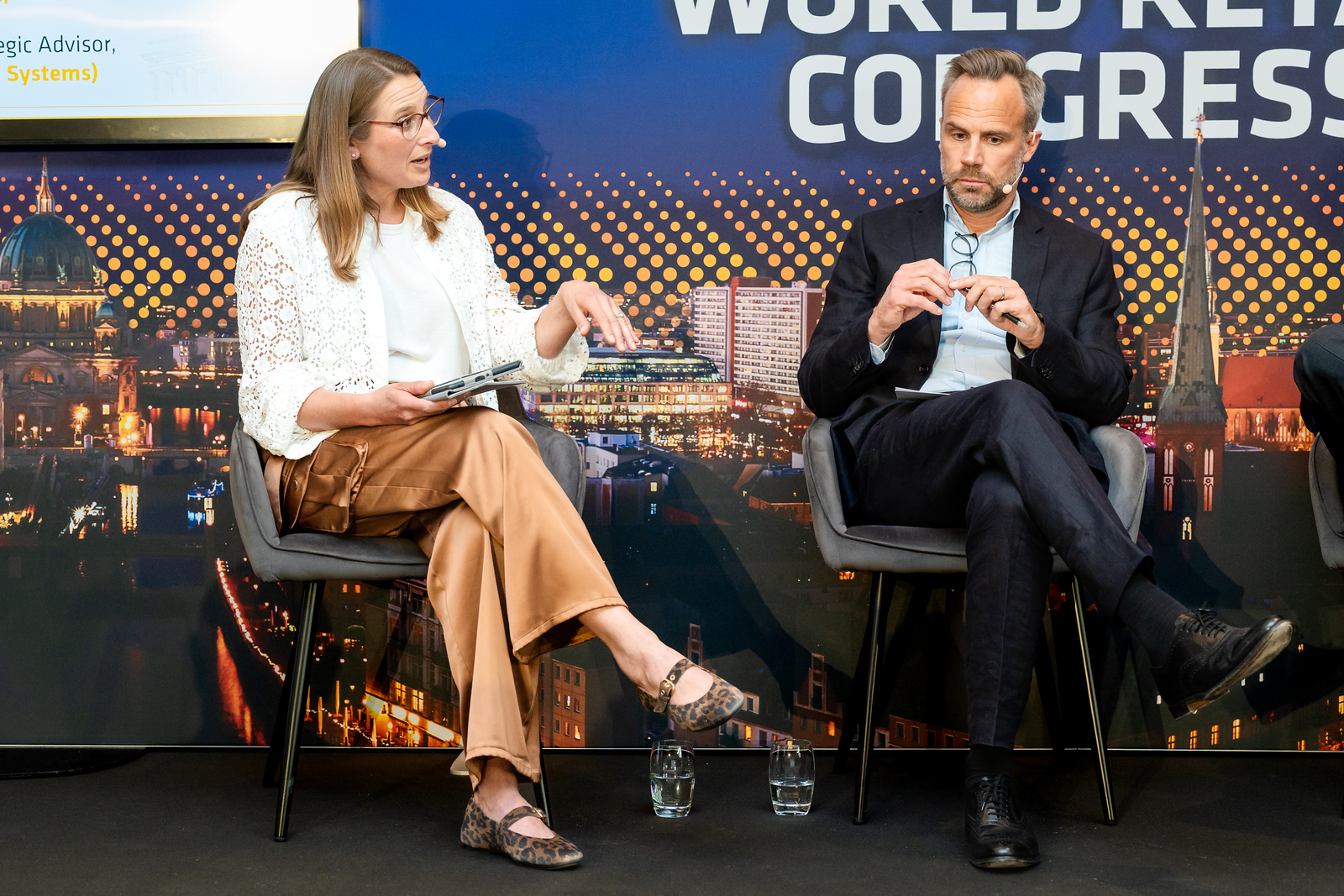
Having spent two days at the World Retail Congress, I've been sitting with a question: can we sell more and consume less at the same time? I think we might be able to - but only if we fundamentally change what selling means.
Working in the circular economy, it can be easy to quietly put overconsumption in the 'too edgy to deal with' box. To cover it up with 'it's not my fault the system doesn't work', which, if I'm honest, is something I have done over the last few years. But it's becoming more and more uncomfortable. The amount of 'stuff' purchased continues to go up. The stress on resources continues to grow. At some point, we can no longer put overconsumption in the 'the system doesn't work' box, or the 'we have to keep producing to keep jobs' box, or whatever box we use to make our own consumption (and selling) patterns feel better.
I am no angel. I don't buy a lot of new clothing, but I do buy fabric with the intention of making new clothing, so make of that what you will. I'm not preaching. But having spent two days at the World Retail Congress recently, I was reminded again that selling more 'stuff' is as strong a message as it has ever been, even in the face of the knowledge that we don't really need that much more of it and that our scarce resources will not be able to keep up with demand.
So the question I've been sitting with since I got home is this: can we sell more and consume less at the same time? Is there a version of retail growth that is actually compatible with a circular economy?
I think there might be. But it requires asking a fundamentally different question about what selling actually means.
What kind of company do you want to be?
In a main stage interview at WRC2026, Bracken Darrell, CEO of VF Corp asked the room a question that has stayed with me: "What kind of company do you want to be?" He talked about the kind of company you have been, the kind you are now, and reminded everyone that you can choose to be something different going forward.
It's a most excellent question because from what I'm hearing across the industry, if you choose to be the same business you are today, reliant on a steady flow of virgin materials, fossil fuels and the same approach to just selling more stuff, you probably won't have a business tomorrow.
We see this playing out in both food and fashion. The impact of climate change and geopolitical instability is squeezing margins. Those organisations that invested in more sustainable activities years ago are weathering the shocks better - literally. In food, companies building regenerative supply chains that support soil health and biodiversity are seeing more stable crop yields. In fashion, businesses that invested in circular business models are seeing growth at four times the rate of business as usual.
At Adidas, the message was clear: control the controllable. Build resilience. Reduce exposure to external shocks. This was echoed in a panel I hosted on circularity and retail resilience. H&M shared how, through their Green Fashion Initiative, they are supporting suppliers to replace fossil fuel-based energy systems with renewable alternatives - electrifying production in a way that not only reduces emissions but insulates their supply chain from the volatility of gas and oil supply. In the news in recent weeks, we hear that those Southeast Asian countries that invested heavily in renewable energy are navigating the Strait of Hormuz disruptions far better than most. Control the controllable.
The message is shifting. Sustainability is no longer something we do to help combat climate change. It is something we have to do as a result of climate change. It builds resilience and lowers risk. That is a very different conversation and a much easier one to have in a boardroom.
So what would circular selling actually look like?
Several themes came up at WRC that I think are ripe for a circular economy makeover. Here are three that got me thinking.
Personalisation - but make it circular
Personalisation is rising fast up the retail agenda. And I get it, it's genuinely exciting. In my house, personalisation with a first name is essentially illegal. With three daughters, anything that can't be passed down because the name is wrong is a problem! But I'm not perfect. There was a moment of weakness a few years ago when I designed my youngest daughter a personalised pair of leopard print Converse high tops with her name down the back. She absolutely loved them! The guilt is still sitting with me. There is unlikely to be another Alys O'Donnell out there, which means those shoes have had precisely one life.
But this got me thinking about how we solved this before. Growing up in Johannesburg, school uniforms were generic - pinafore, shirt, jumper (or jersey as it's called there), etc - and mothers sewed on the school badge themselves to personalise it to the school. When the time came, you simply unpicked it and the jumper moved on to its next life and the badge was sewn onto the next piece of uniform.
We've largely lost those skills (and the patience to sit sewing on badges while watching telly) but we haven't lost the desire for personalisation. So what new approaches can we develop that give us the personalisation buzz of 2026 with the longer-life thinking of 1987? How do we create items that feel personal but are still fit for a circular economy - items that can be rented, remade, resold, reused? This feels like a genuinely interesting design challenge that needs some time devoted to it.
Styling, not just selling
Here's an idea that came to me thinking about RFID tags and the way my teenage daughters talk about fashion. They don't talk about wearing things - they talk about styling them. I have so much to learn but again, how can we lean into this trend to further a circular economy?
Imagine this: you walk into a changing room with an armful of new garments to try on. The RFID tags are read automatically, and a screen suggests items from the store's preloved rail that would work with what you've chosen. You're not just being sold something new, you're being helped to style an outfit. And one or more of the pieces that completes it hasn't added a single new resource to the planet.
That's a retail experience that feels exciting and personal, drives revenue, and actively moves preloved stock. Everyone wins.
30-minute preloved
Myntra in India is now delivering fashion to customers in 30 minutes across ten cities. Ultra-fast fashion, but make it instant. Now, I have never personally experienced a 30-minute fashion emergency, but clearly this is a thing - and it will grow. Not just in India. So how can we make 30-minute fashion circular?
What if 30-minute delivery was only available for preloved, rental or items designed with circular principles? Imagine a platform that connects charity shops across an area, allowing them to upload images of their stock. You browse, click, purchase and your emergency skirt or trouser suit is picked up and delivered to your door. Using AI to help you style a complete outfit from multiple charity retailers, arriving in minutes. Think Cher's wardrobe from the movie Clueless - but entirely preloved. Living on the Isle of Wight this would be an ideal geographical location to trial this kind of technology and approach to 30-minute fashion*.
Brand love becomes brand relove
Luxury fashion has quietly solved the brand love problem - vintage and preloved pieces from the great houses often hold or increase their value over time. The question is how brands outside the luxury sector build the same kind of attachment to their products' second and third lives.
My daughters know that the Iets Frans trackies from Urban Outfitters will hold their quality and retain value on resale platforms like Vinted and Depop. For them, that makes spending a bit more worth it. That's brand relove in action and it's being built not by the brand's marketing team, but by the resale market itself. The brands that are paying attention to how their products perform on resale platforms are already building circular thinking into their design and pricing decisions, whether they call it that or not.
An ex-colleague and I would often discuss how collections could be designed to have more than one life and she had a great idea for some brand relove thinking… every year brands and retailers bring out a denim collection. Let's focus on jeans for a moment. What if the jeans were designed to be worn for a year or two and then they come back and get made into denim shorts for the following year's summer shorts collection. Now, if we build on Primark's or Madewell's remade denim collections and design it for customers to bring their used jeans back to be made into shorts, then we start to see how we weave brand relove and the circular economy together! Exciting.
So - can we sell more but consume less?
Maybe. But only if we stop defining selling as shifting units of new stuff and start defining it as keeping customers in relationship with products, brands and experiences over time. The retailers who figure that out, who make preloved as exciting as new, who use AI to personalise the circular experience rather than just accelerate the linear one, who build resilience into their supply chains rather than just efficiency (see previous thoughts on effectiveness v efficiency), those are the ones who will still be here in twenty years.
What kind of company do you want to be? It's worth sitting with that question a little longer than is comfortable.
*heads to develop business plan and find investors…….*
More writing
Choose effectiveness over efficiency. Always.
Our obsession with efficiency is making the linear economy slightly less bad - but it's not creating a circular one. A case for effectiveness, via a cherry tree, a pot of hummus, and a missing lid.
If the circular economy doesn't improve everyday life, it's not working
The circular economy shouldn't be optional - but for many people, it still is. A case for why local government is the missing piece, and what it looks like when it gets it right.